
How to get commercial cleaning contracts in the UK
Where facilities managers find cleaners, what they check, and how to get on their shortlist.


Quick answer
How to get commercial cleaning contracts? Use one or more of six routes: direct approaches, referrals, subcontracting, tenders, lead platforms and search. Whichever route brings the lead, the buyer usually checks your reviews, insurance and sector experience online before asking for a quote. Make that check easy to pass.
Picture a facilities manager whose cleaner has just given notice. The contract ends in six weeks. There is no time to meet ten firms. They ask a colleague, search Google and write down three names.
That shortlist of three is where your next contract is decided. This guide shows how to find commercial cleaning contracts, how buyers build that shortlist and what they check before they ask for a quote. I work in SEO, so I spend longer on the online check.
Where commercial cleaning contracts come from
Commercial cleaning contracts come from six routes, and most firms use a mix. None is best for everyone.
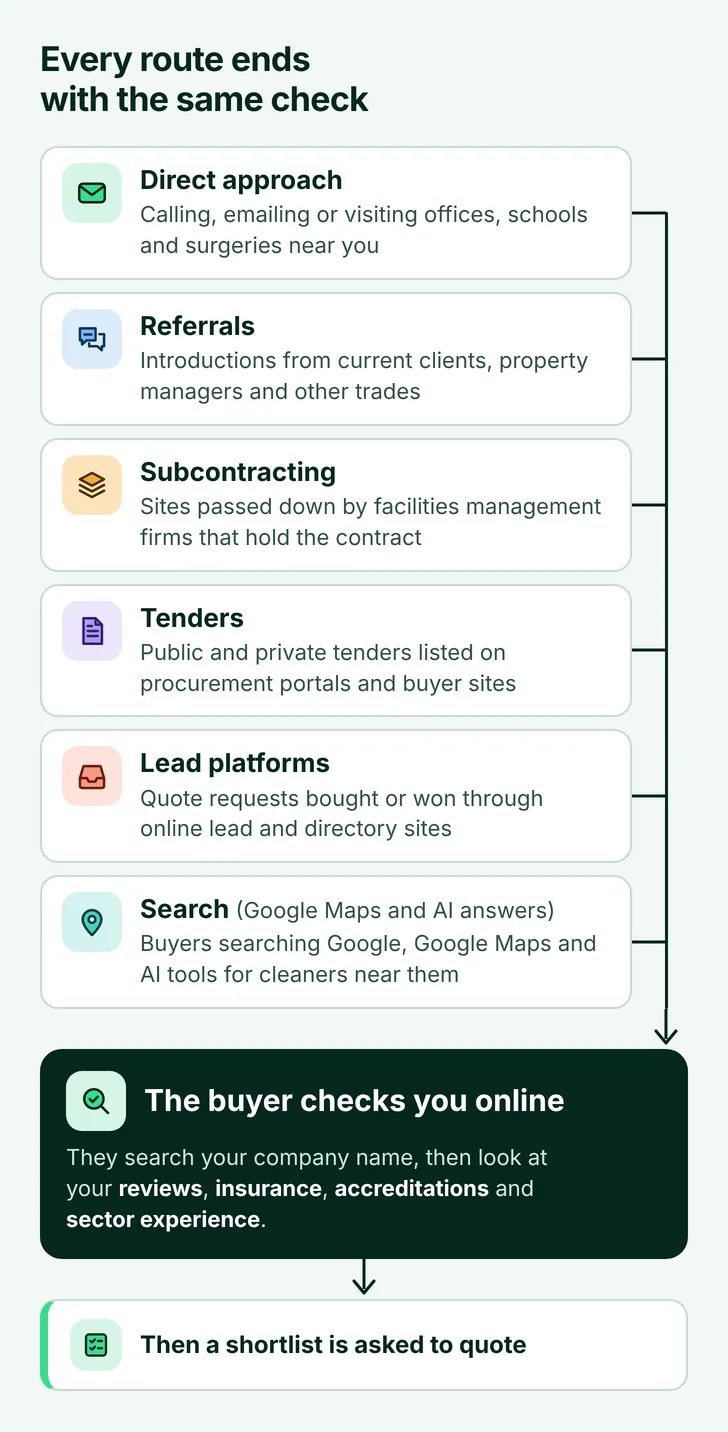
- Direct approach. You contact offices, clinics, schools and shops near you. It is slow, but you control it. Buyers often stay with their current cleaner until renewal, so aim to be remembered when an office cleaning contract comes up.
- Referrals. Existing clients, property managers and neighbouring trades pass your name on. These leads are warm and hard to scale.
- Subcontracting. Facilities management companies hold the client relationship and bring in cleaners for sites. Work is steadier, margins can be tighter, and you depend on one partner.
- Tenders. Public bodies and larger private organisations publish contracts and invite bids. I cover them below.
- Lead platforms. Sites such as Bark pass enquiries to several firms at once. Check that the enquiries match the contracts you want before you rely on them.
- Search. Buyers search Google, Google Maps and AI tools for cleaners near them. This route is open all year and it rewards firms that look trustworthy.
Here is how the routes compare.
| Route | Who you deal with | What they check first |
|---|---|---|
| Direct approach | Office or practice manager | Your website, reviews and sector experience |
| Referral | The person who recommended you, then the buyer | Your reviews and your website |
| Subcontracting | Facilities management company | Insurance, vetting and references |
| Tender | A procurement team | The documents you submit |
| Lead platform | The buyer who posted the enquiry | Your profile, reviews and price |
| Search | Facilities or office manager | Google Maps listing, website and reviews |
How facilities managers find and shortlist cleaners
Facilities managers usually shortlist cleaners by asking around first, then searching online and reading reviews. In my experience, the path looks like this.
- They ask colleagues or neighbouring businesses who they use.
- They search Google for something like “commercial cleaners near me”, or ask an AI tool for suggestions.
- They look at the Google Maps results and note the firms near their building.
- They open a few websites.
- They read reviews, looking for other businesses like theirs.
- They ask two or three firms for a quote.
Steps two to five happen before you know the buyer exists. You are judged on what they can see without speaking to you.
Whichever route a lead arrives by, the buyer will usually search your name before they pick up the phone.
The check can go wrong in ordinary ways. You may have no reviews from commercial clients, so a firm with ten looks safer. You may have one page covering every kind of cleaning, so you never appear for “school cleaning contractors”. Your site may not mention insurance at all, so a competitor that does gets the call.
The firm that is easiest to trust gets asked first, whether or not it is the best.
What buyers check before they ask for a quote
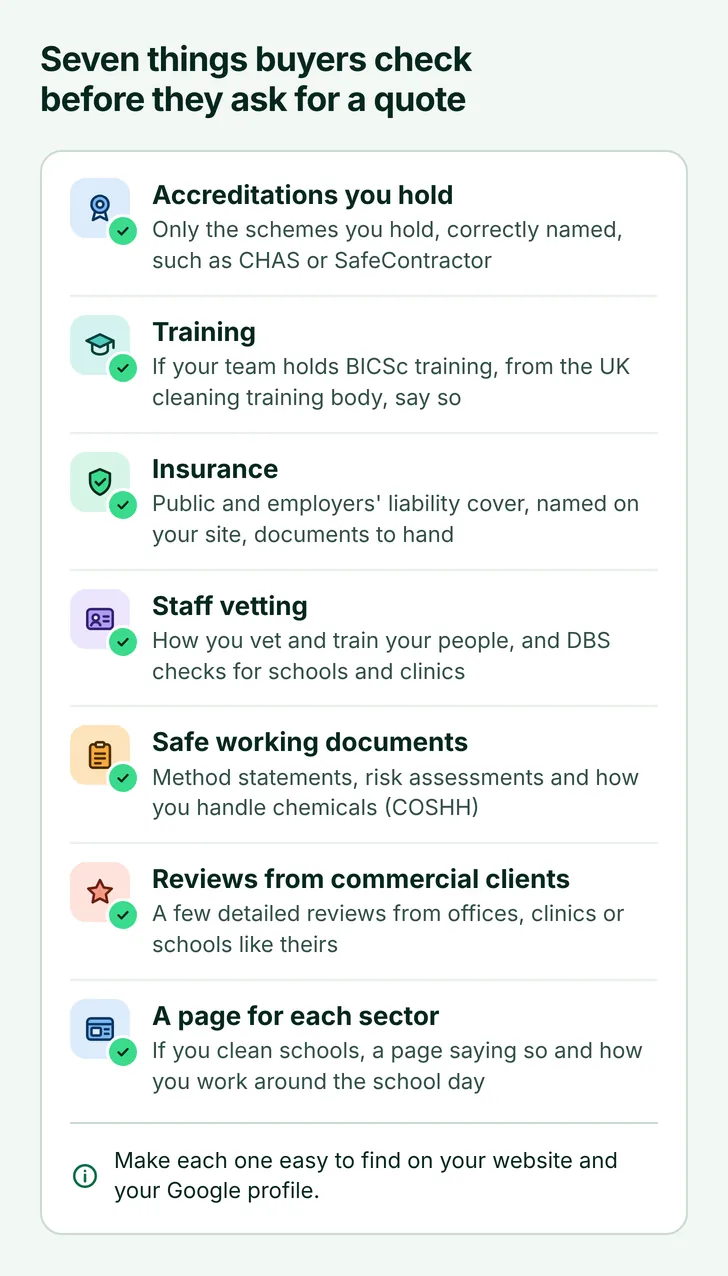
Buyers check your accreditations, training, insurance, vetting, safe working documents, reviews and sector pages. Each is a chance to pass, or a reason to move on.
- Accreditations you hold. Some buyers ask for schemes such as CHAS, SafeContractor or Constructionline, or for ISO 9001. Many contracts ask for none of these. Show only what you hold, with the correct name. Never imply a scheme you do not have.
- Training. The British Institute of Cleaning Science (BICSc) is a UK cleaning training body. If your team holds BICSc training, say so.
- Insurance. Name your public liability insurance. If you employ staff, the law requires employers’ liability insurance of at least £5 million from an authorised insurer, with a few exceptions, and gov.uk explains the employers’ liability rules. Buyers may set minimum cover levels, so read each requirement and keep your policy documents to hand.
- Staff vetting. Schools, clinics and care settings often ask about DBS checks. Say how you vet and train your people.
- Safe working documents. Method statements and risk assessments show how you work. Buyers may also ask how you handle cleaning chemicals under COSHH, the rules on controlling hazardous substances. The Health and Safety Executive explains COSHH.
- Reviews from commercial clients. A buyer wants to see offices, clinics or schools like theirs. A few detailed reviews from commercial clients beat many one-line reviews from domestic customers.
- A page for each sector. If you clean schools, have a page that says so, and says how you work around the school day.
Tip
Put your insurance and any accreditations you hold on the page buyers land on, in plain words, not only inside a PDF.
A buyer with ten minutes is unlikely to open an attachment to find out whether you are insured. They will open the next firm’s website instead.
Cleaning tenders in the UK and when they suit a small firm
Tenders suit a small firm when the lot is local, the specification is clear and you can already show the insurance and documents asked for. A tender is a formal invitation to bid for a contract, used by public bodies and many larger private organisations.
In England, public sector contracts worth over £12,000 including VAT appear on Contracts Finder, and high value contracts appear on Find a Tender. Scotland, Wales and Northern Ireland have their own portals: Public Contracts Scotland, Sell2Wales and eTendersNI. Thresholds change, so check gov.uk before you rely on a figure. I am not a procurement or legal adviser, so treat this as orientation, not advice.
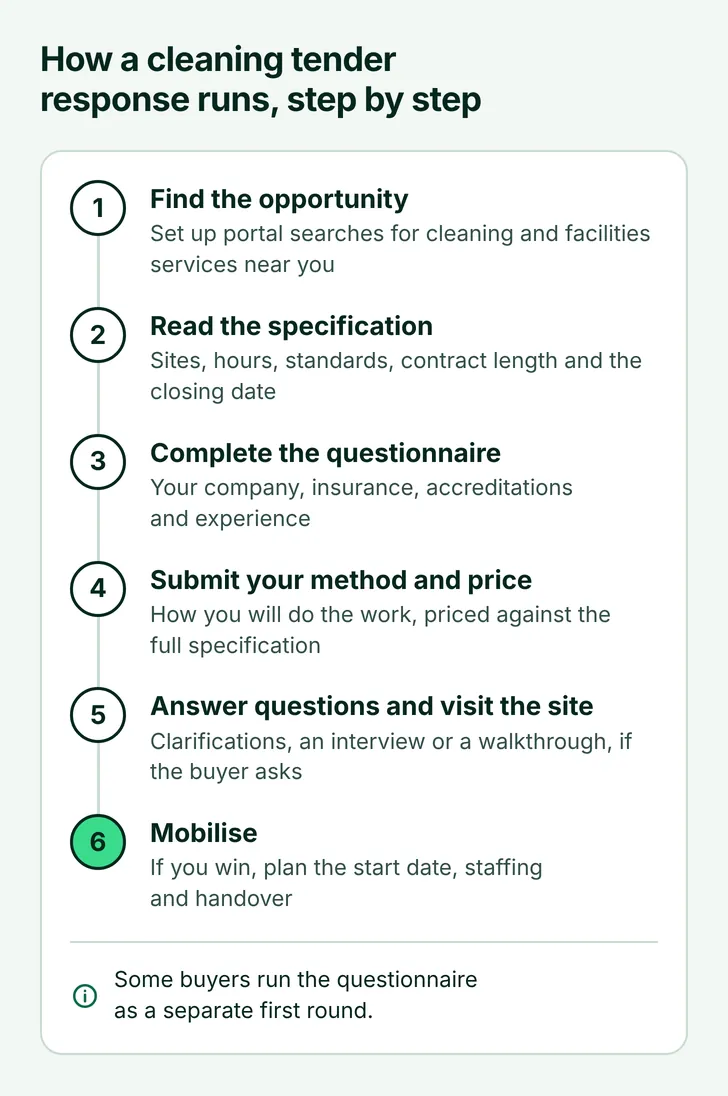
Most tenders follow a similar path.
- Find the opportunity. Set up searches on the portals for cleaning and facilities services in your area.
- Read the specification. Check the sites, hours, standards, contract length and closing date before anything else.
- Complete the questionnaire. This asks about your company, insurance, accreditations and experience. It is often called a selection questionnaire.
- Submit your method and price. Method statements explain how you will do the work. Price it against the full specification.
- Answer questions and visit the site. Buyers may ask for clarifications, an interview or a walkthrough.
- Mobilise. If you win, you plan the start date, staffing and handover.
Tenders suit you less when the requirements are far beyond what you can evidence today. Some set minimum standards, and a long questionnaire costs real time.
How to get commercial cleaning contracts when you are small
To win cleaning contracts as a small firm, start with one-site offices, quote fast and build proof before you chase bigger work. Here is how I would do it.
- Start with small offices. Contracts with one site and a clear scope build your record without stretching your team.
- Offer a site walkthrough. Walk the building with the manager, then send a written scope and price within a day or two. A clear quote stands out.
- Get your paperwork ready first. Have insurance, vetting records and a short method statement ready before you pitch.
- Subcontract to build proof. Working for a facilities management company or a larger cleaner gives you sites, references and experience. Agree the terms in writing.
- Ask early clients for reviews. Ask after a good month, not at the start. Ask for a review that names the type of building and the work.
- Be honest about capacity. Do not promise cover you cannot staff. A missed shift can cost you a contract faster than a modest quote does.
Winning a first commercial contract is slow. Do a few small ones well and the next, larger one gets easier.
How to be the company buyers find when they search
To be the company buyers find, complete your Google Business Profile, collect reviews from commercial clients, build a page for each sector and keep your details consistent. Buyers search before they call, so this is the part you can improve most directly.
- A complete Google Business Profile. Add your services and the areas you cover, even without a shopfront. Use real photos of your team at work.
- Reviews from commercial clients. Ask honestly and never offer rewards.
- A page for each sector. Offices, schools, medical premises and facilities each get their own page, written around what that buyer checks.
- Consistent details. Your name, phone number and any address you show should match on your website and every listing.
One London commercial cleaning company shows what this looks like. In 6 months its position for “commercial cleaners london” moved from 10 to 2.9, from the client’s own Google Search Console. Its Google profile also recorded 127 calls from May to October 2026 (up 11.1%), from the client’s own Business Profile. That is one client over the periods named, not a forecast for yours.
Buyers still decide who they hire. The work only makes you easier to find and to trust. You can see more client results.
If you want help with this side, my page on SEO for cleaning companies explains what I do. The general method sits on my local SEO services page. Or book a free website audit and I will show you where you appear today.
Make the check easy to pass.
Commercial cleaning contracts: common questions
How do I get my first commercial cleaning contract?
To get commercial cleaning contracts as a new firm, start small. Approach offices, clinics or shops near you, offer a site walkthrough and send a clear written scope and price. Have your insurance and vetting ready before you pitch. Ask each early client for a review and a reference. A few small contracts done well open the door to larger ones.
Are cleaning tenders worth it for a small company?
Sometimes. Tenders suit firms that can show insurance, written procedures and enough capacity, and they take time to complete. Look for smaller local lots and read the requirements first, since some set minimum standards. If a tender asks for far more than you can show today, spend that time on direct approaches and referrals instead.
Do I need CHAS or SafeContractor to win contracts?
Not for every contract. Some buyers ask for a scheme such as CHAS or SafeContractor, often to pre-qualify suppliers, and many do not. Check what your target buyers ask for in their tender documents or supplier forms. Show only the schemes you hold, with their correct names, and never imply membership you do not have.
What insurance do I need for commercial cleaning contracts?
Most buyers expect public liability insurance. If you employ staff, employers’ liability insurance of at least £5 million is a legal requirement, with a few exceptions. Buyers and tenders may set minimum cover levels, so read each requirement before you bid. A broker can advise on the right cover for your work, and gov.uk explains the employers’ liability rules.
What happens to staff when I take over an existing cleaning contract?
Under TUPE, a change of cleaning contractor can count as a service provision change, so the cleaners on that contract may transfer to the new provider on their existing terms. Whether it applies depends on the facts of each case. Ask the buyer early for staffing details, and take advice before you price. Gov.uk explains the basics.
Let’s see where you stand
Book a free 15-minute website audit. I’ll show you how you show up on Google Maps and in AI answers, and the 3 fixes that matter most.